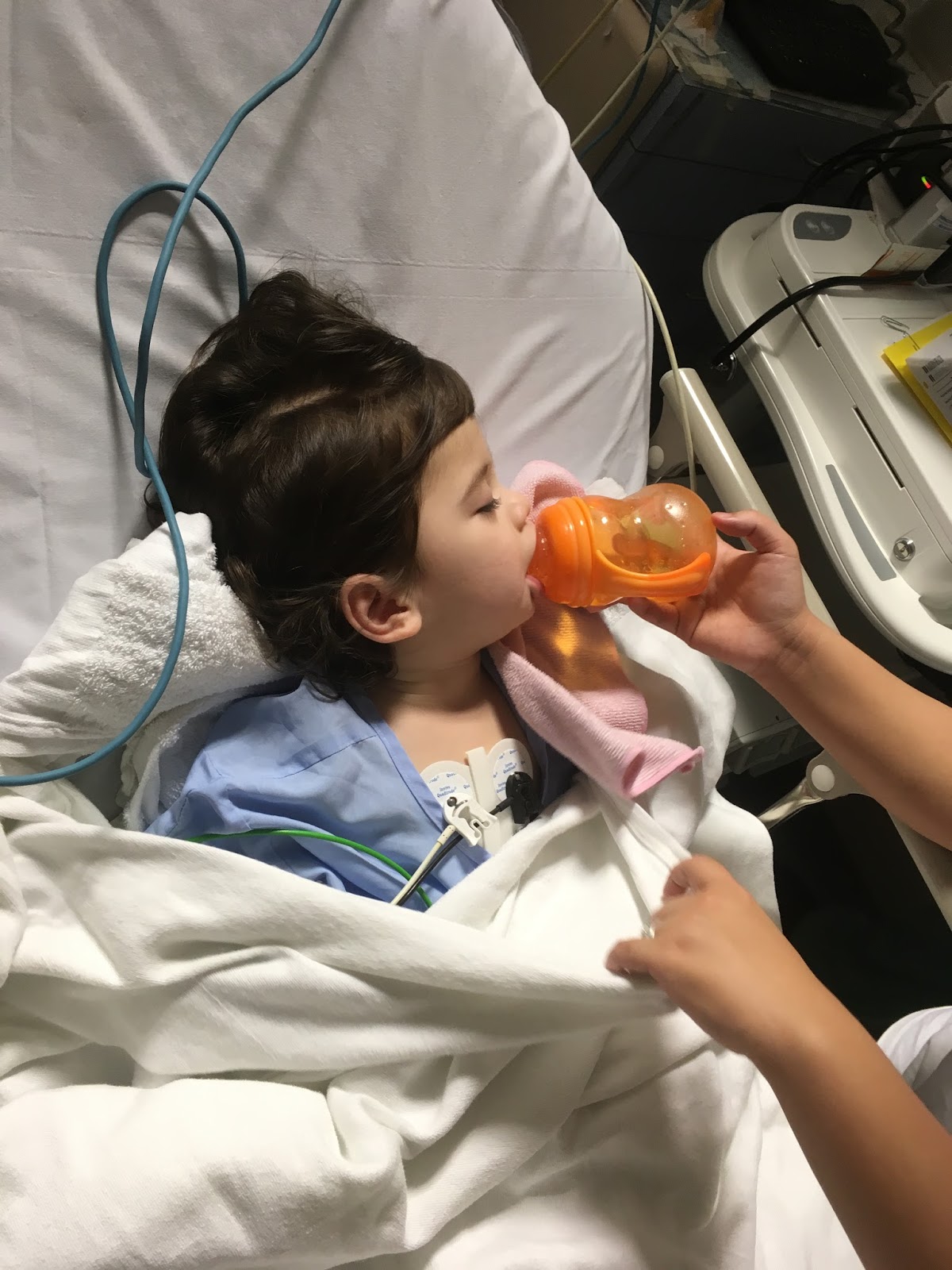
An invaluable service for us has been the New Jersey Early Intervention (EI) program. It was introduced to us by another couple whose daughter had also dealt with Infantile Spasms. It was described to us as a service that would allow for Rhythm to receive the kind of therapy she needs to help re-teach her brain all of those things that were set behind as a result of her type of Epilepsy and associated developmental delays.
As we met with the coordinators of the EI program and learned what they would be able to do, I felt confident that Rhythm would have a great support structure going forward. It wasn't just physical therapy to help her learn how to use her limbs and eventually crawl and walk. It was everything else that a child does that we take for granted, like playing and eating.
Rhythm has qualified for Physical Therapy, Occupational Therapy, Vision Therapy, Speech Therapy and Feeding Therapy. It's overwhelming, especially for Rhythm, but every day, kind and caring people are helping our daughter learn and meet milestones for development that still lay in front of her. She has at least one therapy session a day.

Rhythm has now been nearly three months seizure free. This has really allowed us to focus on her therapy, on teaching her things and watch as she slowly learns things on her own. Our speech therapist has described the many sounds that Rhythm makes (raspberries, etc) as her own language. If we notice trends and when she uses these sounds, we may begin to understand sometimes what she wants until she learns to form words.
With a lively, but non-verbal child, I often find myself wondering: What's going on inside that little head of yours, Rhythm? It's a world I think she is trying to share with us. We just have to be patient.
Each state has an Early Intervention Program. If you have a child under 3 years of age, and have not heard of Early Intervention or had a chance to reach out to them yet, below is the contact information for each state in the US, along with US Territories, and a link to a website that summarizes the program.
State Coordinators for Early Intervention
List as of 9/14/2017
Alabama
- Elizabeth Prince, Part C Coordinator
- Early Intervention Program
- Department of Rehabilitation Services
- 602 South Lawrence Street
- Montgomery, AL 36104
- Phone: (334) 293-7166
- Fax: (334) 293-7375
- Email: betsy.prince@rehab.alabama.gov
- Website: http://rehab.alabama.gov/individuals-and-families/early-intervention/
- ReferPhone: 800-543-3098
- ReferWebsite: http://rehab.alabama.gov/individuals-and-families/early-intervention/ei-general-information
Alaska
- Maureen Harwood, Early Intervention Manager/Part C Coordinator
- Division of Senior and Disabilities Services
- Alaska Department of Health and Social Services
- 751 Old Richardson Highway, Suite 100A
- Fairbanks, AK 99701
- Phone: (907) 451-5041
- AltPhone1: (800) 770-1672
- AltPhone2: (877) 477-3659
- Fax: (907) 269-3497
- Email: maureen.harwood@alaska.gov
- Website: http://dhss.alaska.gov/dsds/Pages/infantlearning/default.aspx
American Samoa
- Ruth Te'o, Acting Part C Coordinator
- Department of Health
- Helping Hands Early Intervention Program
- Early Hearing Detection and Intervention
- PO Box 7477
- Pago Pago, AS 96799
- Phone: (684) 699-4987
- Fax: (684) 699-4985
- Email: rteo@doh.as
- Website: http://www.helpinghands-as.org/index.html
Arizona
- Maureen Casey, Part C Coordinator
- Arizona Early Intervention Program
- Department of Economic Security
- 3839 North 3rd Street, Suite 304
- Site Code #801 A-6
- Phoenix, AZ 85012
- Phone: (602) 771-5376
- AltPhone1: (888) 439-5609 (in AZ)
- Fax: (602) 200-9820
- Email: MCasey@azdes.gov
- Website: https://des.az.gov/services/disabilities/developmental-infant
- ReferPhone: (602) 532-9960 or (888) 439-5609 (outside Maricopa)
- ReferWebsite: https://extranet.azdes.gov/azeip/azeipref/Forms/Categories.aspx
Arkansas
- Tracy Turner, Part C Coordinator
- Department of Human Services
- Division of Developmental Disabilities
- PO Box 1437, Slot N504
- Little Rock, AR 72203-1437
- Phone: (501) 682-8703
- AltPhone1: (501) 682-8670
- AltPhone2: (800) 643-8258 (in AR)
- Fax: (501) 682-8890
- Email: tracy.turner@dhs.arkansas.gov
- Website: https://dhs.arkansas.gov/dds/firstconnectionsweb/#fc-home
- ReferPhone: (800) 643-8258
- ReferWebsite: https://dhs.arkansas.gov/dds/firstconnectionsweb/#fc-referrals
Bureau of Indian Education
- Sue Bement, Acting Supervisory Ed Specialist, Early Childhood
- Division of Performance and Accountability
- Bureau of Indian Education/Albuquerque Service Center
- 1011 Indian School Road, NW, Suite 332
- Albuquerque, NM 87104
- Phone: (505) 563-5274
- Fax: (505) 563-5281
- Email: sue.bement@bie.edu
- Website: http://www.bie.edu/
- ReferPhone: See regional phone numbers at the Referral Website
- ReferWebsite: http://www.ectacenter.org/topics/bie/biecontacts.asp
California
- Sharon DeRego, Manager/Part C Coordinator
- Monitoring and Family Services Branch
- Department of Developmental Services
- 1600 9th Street, MS 3-11
- Sacramento, CA 95814
- Phone: (916) 654-3681
- AltPhone1: (800) 515-2229
- Fax: (916) 654-3255
- Email: sharon.derego@dds.ca.gov
- Website: http://www.dds.ca.gov/EarlyStart/Home.cfm
- ReferPhone: (800) 515-BABY
- ReferWebsite: http://www.dds.ca.gov/EarlyStart/WhatsES.cfm
Colorado
- Christy Scott, Early Intervention Program Director/Part C Coordinator
- CDHS Office of Early Childhood
- Division of Community and Family Support
- 1575 Sherman Street, 1st Floor
- Denver, CO 80203
- Phone: (303) 866-2664
- Fax: (303) 866-5200
- Email: christy.scott@state.co.us
- Website: http://www.eicolorado.org
- ReferPhone: (888) 777-4041
- ReferWebsite: http://coloradoofficeofearlychildhood.force.com/eicolorado/EI_QuickLinks?p=home&s=Make-a-Referral&lang=entUs.Main&content=state
Connecticut
- Lynn Skene Johnson, Part C Coordinator
- Birth to Three System
- Office of Early Childhood
- 165 Capitol Avenue
- Hartford, CT 06106-1308
- Phone: (860) 713-5013
- Fax: (860) 418-6003
- Email: lynn.s.johnson@ct.gov
- Website: http://www.birth23.org/
- ReferPhone: (800) 505-7000
- ReferWebsite: http://www.birth23.org/referrals/
Delaware
- Nancy Smith, Part C Coordinator
- Birth to Three Early Intervention System
- Herman M. Holloway, Sr. Campus
- Main Administration Building
- 1901 N. DuPont Highway, Suite 249
- New Castle, DE 19720
- Phone: (302) 255-9137
- Fax: (302) 255-4407
- Email: Nancy.Smith@state.de.us
- Website: http://www.dhss.delaware.gov/dhss/dms/epqc/birth3/directry.html
- ReferPhone: (800) 671-0050 (New Castle County) and (800) 752-9393 (Kent and Sussex Counties)
- ReferWebsite: http://www.dhss.delaware.gov/dhss/dms/birth3pubs.html
Department of Defense
- Naomi Younggren, Program Manager
- Educational and Developmental Intervention Services, Health Policy and Services
- HQ, US Army Medical Command
- Europe Regional Medical Command
- Attn: Behavioral Health Division (BHD)/EDIS Unit 29421
- APO AE, 09136-9421
- Phone: 00149-6302-67-8877
- AltPhone1: 00149-171-778-7604
- Email: naomi.o.younggren.civ@mail.mil
- Website: https://www.edis.army.mil/index.html
- ReferWebsite: https://www.edis.army.mil/eisprocess.html
District of Columbia
- Allan Phillips, Special Assistant Part C
- Office of the State Superintendent of Education (OSSE)
- Strong Start DC Early Intervention Program (DCEIP)
- Division of Early Learning - Government of the District of Columbia
- 810 First Street, N.E. , 9th Floor
- Washington, DC 20002
- Phone: 202-741-0475
- AltPhone1: 202-412-7593 (cell)
- Email: allan.phillips@dc.gov
- Website: http://osse.dc.gov/service/strong-start-dc-early-intervention-program-dc-eip
- ReferPhone: (202) 727-3665
- ReferWebsite: http://osse.dc.gov/service/strong-start-dc-early-intervention-program-dc-eip-screening-and-referral-information
Florida
- Renee Jenkins, Early Steps Administrator
- Bureau of Early Steps & Newborn Screening
- Division of Children's Medical Services
- Florida Department of Health
- 4052 Bald Cypress Way, Bin A09
- Tallahassee, FL 32399-1707
- Phone: (850) 245-4456
- Fax: (850) 922-5385
- Email: Renee.Jenkins@flhealth.gov
- Website: http://www.floridahealth.gov/AlternateSites/CMS-Kids/families/early_steps/early_steps.html
- ReferPhone: (800) 218-0001
- ReferWebsite: http://www.earlystepsdirectory.com
Georgia
- Sally Cannon, Part C Coordinator
- Children and Youth with Special Health Care Needs
- Georgia Department of Public Health
- 2 Peachtree Street, 11th Floor
- Atlanta, GA 30303
- Phone: (404) 657-2869
- Fax: (678) 605-6925
- Email: sally.cannon@dph.ga.gov
- Website: http://dph.georgia.gov/Babies-Cant-Wait
- ReferWebsite: http://dph.georgia.gov/services-babies-cant-wait
Guam
- Cathy Tydingco, Part C Coordinator
- Division of Special Education
- Department of Education
- PO Box DE
- Hagåtña, GU 96932
- Phone: (671) 300-5776
- Fax: (671) 647-4401
- Email: cbtydingco@gdoe.net
- Website: https://sites.google.com/a/gdoe.net/geis/home
- ReferPhone: (671) 300-5776 or (671) 300-5816
- ReferWebsite: https://sites.google.com/a/gdoe.net/geis/make-a-referral
Hawaii
- Charlene Robles, EIS Supervisor/Part C Coordinator
- Department of Health
- Early Intervention Section
- 1350 South King Street, Suite 200
- Honolulu, HI 96814
- Phone: (808) 594-0007
- Fax: (808) 594-0015
- Email: charlene.robles@doh.hawaii.gov
- Website: http://health.hawaii.gov/eis/
- ReferPhone: (808) 594-0066 (for Oahu or 1-800-235-5477 for Neighbor Islands)
Idaho
- Christy Cronheim, Program Manager
- Children's Developmental Services
- State Department of Health and Welfare
- 450 West State Street, 5th Floor
- PO Box 83720
- Boise, ID 83720-0036
- Phone: (208) 334-5590
- AltPhone1: (800) 926-2588
- AltPhone2: (208) 332-7205 (TTY)
- Fax: (208) 332-7330
- Email: cronheic@dhw.idaho.gov
- Website: http://healthandwelfare.idaho.gov/default.aspx?TabId=78
- ReferPhone: (208) 334-6530
Illinois
- Ann Freiburg, Part C Coordinator
- Department of Human Services
- Bureau of Early Intervention
- 823 East Monroe
- Springfield, IL 62701
- Phone: 217-782-0516
- Fax: (217) 524-6248
- Email: ann.freiburg@illinois.gov
- Website: http://www.dhs.state.il.us/page.aspx?item=32009
- ReferPhone: (800) 323-4769
- ReferWebsite: http://www.dhs.state.il.us/page.aspx?module=12&OfficeType=4&County
Indiana
- Christina Commons, Director
- First Steps
- Bureau of Child Development
- Division of Disability Rehabilitation
- 402 West Washington Street, Rm 451, MS51
- Indianapolis, IN 46204
- Phone: (317) 232-1147
- AltPhone1: (800) 441-7837 (in IN)
- Fax: (317) 234-6701
- Email: Christina.Commons@fssa.in.gov
- Website: http://www.in.gov/fssa/4655.htm
- ReferPhone: (800) 545-7763
- ReferWebsite: http://www.in.gov/fssa/ddrs/2814.htm
Iowa
- Cindy Weigel, State Coordinator
- Early ACCESS (IDEA/Part C)
- Iowa Department of Education
- Bureau of Early Childhood Services
- 400 E. 14th Street
- Des Moines, IA 50319
- Phone: (515) 281-8634
- Fax: (515) 242-5988
- Email: cindy.weigel@iowa.gov
- Website: https://www.educateiowa.gov/pk-12/early-childhood/early-access
- ReferPhone: (888) 425-4371
- ReferWebsite: http://www.iafamilysupportnetwork.org/early-access-iowa/what-is-ea
Kansas
- Heather Staab, Part C Coordinator
- Infant-Toddler Services, Special Health Services
- Bureau of Family Health
- Kansas Department of Health and Environment
- 1000 SW Jackson, Suite 220
- Topeka, KS 66612
- Phone: 785-296-2245
- AltPhone1: (800) 332-6262 (in KS)
- Fax: 785-296-8616
- Email: heather.staab@ks.gov
- Website: http://www.ksits.org
- ReferPhone: (785) 296-6135 or (800) 332-6262
- ReferWebsite: http://www.ksits.org/download/network_brochure.pdf
- Heather Smith, Director, Special Health Service
- Infant-Toddler Services
- Kansas Department of Health and Environment
- 1000 SW Jackson, Suite 220
- Topeka, KS 66612
- Phone: 785-296-4747
- AltPhone1: (800) 332-6262 (in KS)
- Fax: 785-296-8616
- Email: heather.smith@ks.gov
- Website: http://www.kdheks.gov/cds/index.html
- ReferPhone: (785) 296-6135 or (800) 332-6262
- ReferWebsite: http://www.ksits.org/download/network_brochure.pdf
Kentucky
- Paula Goff, Part C Coordinator
- First Steps
- Early Childhood Development Branch
- Department for Public Health
- 275 East Main Street, HS2WC
- Frankfort, KY 40621
- Phone: (502) 564-3756
- Fax: (502) 564-8389
- Email: paula.goff@ky.gov
- Website: http://chfs.ky.gov/dph/firststeps.htm
- ReferPhone: (877) 417-8377
- ReferWebsite: http://chfs.ky.gov/dph/firststeps/default.htm
Louisiana
- Brenda Sharp, Part C Coordinator
- Office for Citizens with Developmental Disabilities
- PO Box 3117
- 628 North Fourth Street, Bin #21
- Baton Rouge, LA 70821-3117
- Phone: (225) 342-0095
- Fax: (225) 342-8823
- Email: brenda.sharp@la.gov
- Website: http://new.dhh.louisiana.gov/index.cfm/page/139/n/139
- ReferPhone: (866) 327-5978
- ReferWebsite: http://new.dhh.louisiana.gov/index.cfm/page/215
Maine
- Janice E. Breton, Acting CDS State Director; State Director of Special Services
- Child Development Services
- Department of Education
- State House Station #146
- Augusta, ME 04333
- Phone: (207) 624-6676
- Fax: (207) 624-6661
- Email: janice.breton@maine.gov
- Website: http://www.maine.gov/doe/cds/
- ReferPhone: (877) 770-8883
- ReferWebsite: http://www.maine.gov/doe/cds/families/referrals/
Maryland
- Brian Morrison, Part C Coordinator
- Maryland Infants and Toddlers Program
- Div. of Special Education/Early Intervention Services
- State Department of Education
- 200 West Baltimore Street, 9th Floor
- Baltimore, MD 21201
- Phone: (410) 767-0863
- Fax: (410) 333-8165
- Email: bmorrison@msde.state.md.us
- Website: http://archives.marylandpublicschools.org/msde/divisions/earlyinterv/infant_toddlers/about/message.htm
- ReferPhone: (800) 535-0182
- ReferWebsite: http://ei.mdecgateway.org/
Massachusetts
- Ron Benham, Part C Coordinator
- State Department of Public Health
- 250 Washington Street, 5th Floor
- Boston, MA 02108-4619
- Phone: (617) 624-5901
- AltPhone1: (617) 624-5070
- AltPhone2: (617) 624-6001 (TTY)
- Fax: (617) 624-5927
- Email: ron.benham@state.ma.us
- Website: http://www.mass.gov/eohhs/gov/departments/dph/programs/family-health/early-intervention/
- ReferPhone: (800) 905-8437 (EI Central Directory)
- ReferWebsite: http://www.mass.gov/eohhs/gov/departments/dph/programs/family-health/early-intervention/family-info/
Michigan
- Vanessa Winborne, Part C Coordinator
- Early On Michigan
- Office of Early Childhood Education and Family Services
- State Department of Education
- PO Box 30008
- Lansing, MI 48909-7508
- Phone: (517) 335-4865
- Fax: (517) 373-7504
- Email: winbornev@michigan.gov
- Website: http://www.michigan.gov/mde/0,4615,7-140-43092-127141--,00.html
- ReferPhone: (800) 327-5966
- ReferWebsite: https://1800earlyon.org/online_referral.php
Minnesota
- Kara Tempel, Part C Coordinator
- State Department of Education
- Early Learning Services
- 1500 Highway 36 West
- Roseville, MN 55113-4266
- Phone: (651) 582-8495
- Fax: (651) 797-1610
- Email: kara.tempel@state.mn.us
- Website: http://education.state.mn.us/MDE/fam/ecse/
- ReferPhone: (866) 693-4769
- ReferWebsite: http://helpmegrowmn.org/HMG/index.htm
Mississippi
- Stacy Callender, Early Intervention Director
- MS First Steps Early Intervention Program
- Mississippi State Department of Health
- 570 East Woodrow Wilson, Osborne 204
- PO Box 1700
- Jackson, MS 39215-1700
- Phone: (601) 576-7816
- Fax: (601) 576-7540
- Email: stacy.callender@msdh.ms.gov
- Website: http://www.msdh.state.ms.us/msdhsite/index.cfm/41,0,74,767,html
- ReferPhone: (800) 451-3903 (in MS)
- ReferWebsite: http://www.msdh.state.ms.us/msdhsite/index.cfm/41,0,74,324,html
Missouri
- Pam Thomas, Part C Coordinator
- Department of Elementary and Secondary Education
- Early Intervention Services
- PO Box 480
- Jefferson City, MO 65102-0480
- Phone: (573) 751-3559
- Fax: (573) 526-4404
- Email: pam.thomas@dese.mo.gov
- Website: http://dese.mo.gov/special-education/first-steps
- ReferPhone: (866) 583-2392
- ReferWebsite: http://dese.mo.gov/special-education/first-steps/how-make-referral
Montana
- Wendy Studt, Part C Coordinator
- Developmental Disabilities Program
- Community Services Bureau
- Department of Public Health and Human Services
- PO Box 4210
- Helena, MT 59604-4210
- Phone: (406) 444-5647
- Fax: (406) 444-0230
- Email: wstudt@mt.gov
- Website: http://dphhs.mt.gov/dsd/developmentaldisabilities/PartC-EarlyInt/partchome/aboutpartc
- ReferPhone: See regional phone numbers at the Referral Website
- ReferWebsite: http://www.dphhs.mt.gov/fssac/providers.pdf
Nebraska
- Amy Bunnell, Part C Co-Coordinator
- Early Development Network
- Nebraska Department of Education
- 301 Centennial Mall South
- Lincoln, NE 68509
- Phone: (402) 471-0817
- Fax: (402) 471-5022
- Email: amy.bunnell@nebraska.gov
- Website: http://edn.ne.gov/cms/
- ReferPhone: (888) 806-6287
- ReferWebsite: http://edn.ne.gov/cms/products/family-members
- Julie Docter, Part C Co-Coordinator
- School Based Services/Early Development Network
- DHHS - Medicaid & Long-Term Care
- 301 Centennial Mall South, 5
- P.O. Box 95026
- Lincoln, NE 68509-5026
- Phone: (402) 471-1733
- Fax: (402) 471-9092
- Email: Julie.Docter@nebraska.gov
- Website: http://edn.ne.gov/cms/
Nevada
- Brenda Bledsoe, Part C Coordinator
- Department of Health and Human Services
- Director�s Office, IDEA Part C Office
- 4126 Technology Way, Ste 100
- Carson City, NV 89706
- Phone: (775) 687-0554
- Fax: (775) 687-0599
- Email: bbledsoe@dhhs.nv.gov
- Website: http://dhhs.nv.gov/Programs/IDEA/PartC/
- ReferPhone: (800) 522-0066
- ReferWebsite: http://dhhs.nv.gov/Programs/IDEA/Early_Intervention_Programs/
New Hampshire
- Kerry Wiley, Part C Coordinator
- Family Centered Early Supports and Services
- Bureau of Developmental Services
- Department of Health and Human Services
- 129 Pleasant Street
- Concord, NH 03301
- Phone: (603) 271-5686
- AltPhone1: (603) 271-3783
- Fax: (603) 271-4902
- Email: Kerry.Wiley@dhhs.nh.gov
- Website: http://www.dhhs.nh.gov/dcbcs/bds/earlysupport/index.htm
- ReferPhone: (800) 298-4321
- ReferWebsite: http://www.dhhs.nh.gov/dcbcs/bds/earlysupport/refer.htm
New Jersey
- Terry Harrison, Part C Coordinator
- Early Intervention System
- Division of Family Health Services
- Department of Health
- PO Box 364
- Trenton, NJ 08625-0364
- Phone: (609) 777-7734
- AltPhone1: (800) 322-8174 (Childfind Birth-21)
- Fax: (609) 777-7739
- Email: terry.harrison@doh.state.nj.us
- Website: http://nj.gov/health/fhs/eis/index.shtml
- ReferPhone: (888) 563-4463
- ReferWebsite: http://nj.gov/health/fhs/documents/schs_cmu.pdf
New Mexico
- Jeanne DuRivage, Program Manager
- Family Infant and Toddler Services
- State Department of Health/DDSD
- 810 San Mateo
- Santa Fe, NM 87506
- Phone: 505-476-8842
- Fax: (505) 476-8992
- Email: Jeanne.DuRivage@state.nm.us
- Website: http://nmhealth.org/about/ddsd/cpb/fit/
- ReferPhone: (877) 696-1472
- ReferWebsite: http://archive.nmhealth.org/ddsd/nmfit/Referral/Referral.htm
- Andy Gomm, Acting Bureau Chief
- Child and Family Supports
- State Department of Health/DDSD
- 810 San Mateo
- Santa Fe, NM 87506
- Phone: (505) 476-8975
- Fax: (505) 476-8992
- Email: andrew.gomm@state.nm.us
- Website: http://nmhealth.org/about/ddsd/cpb/fit/
- ReferPhone: (877) 696-1472
- ReferWebsite: http://archive.nmhealth.org/ddsd/nmfit/Referral/Referral.htm
New York
- Brenda Knudson Chouffi, Director
- Bureau of Early Intervention
- State Department of Health
- Corning Tower Building, Room 287
- Empire State Plaza
- Albany, NY 12237-0660
- Phone: (518) 473-7016
- AltPhone1: (800) 522-5006 ("Growing Up Healthy" 24-Hour Hotline)
- Fax: (518) 486-1090
- Email: brenda.knudsonchouffi@health.ny.gov
- Website: http://www.health.ny.gov/community/infants_children/early_intervention/
- ReferPhone: (800) 577-2229 (in NYC)
North Carolina
- Jill Singer, EI Branch Head
- Early Intervention Branch
- Women's and Children's Health Section, Division of Public Health
- 5605 Six Forks Road
- 1916 Mail Service Center
- Raleigh, NC 27699-1916
- Phone: (919) 707-5520
- Fax: (919) 870-4834
- Email: jill.singer@dhhs.nc.gov
- Website: http://www.beearly.nc.gov/index.php/
- ReferPhone: (919) 707-5520
- ReferWebsite: http://www.beearly.nc.gov/index.php/contact/cdsa
North Dakota
- Amanda Carlson, Part C Coordinator
- Developmental Disabilities Division
- Department of Human Services
- 1237 West Divide Avenue, Suite 1A
- Bismarck, ND 58501
- Phone: (701) 328-8936
- AltPhone1: (800) 755-8529 (In ND)
- Fax: (701) 328-8969
- Email: arcarlson@nd.gov
- Website: http://www.nd.gov/dhs/services/disabilities/earlyintervention/
- ReferPhone: (800) 755-8529
- ReferWebsite: http://www.nd.gov/dhs/services/disabilities/earlyintervention
Northern Mariana Islands
- Robin Palacios, Coordinator
- CNMI Public Schools
- PO Box 504137CK
- Saipan, MP 96950
- Phone: (670) 483-3903
- AltPhone1: (670) 483-3902
- Fax: (670) 664-4845
- Email: robin.palacios@cnmipss.org
- Website: http://chcc.gov.mp/index.php/division-of-public-health/maternal-child-health-mch-program/child-development-assistance-center
Ohio
- Nathan DeDino, State Part C Coordinator
- Kimberly Hauck, Assistant Deputy Director, Department of DD
- State Department of Developmental Disabilities
- 30 E. Broad Street
- Columbus, OH 43215
- Phone: (614) 644-7580 (DeDino)
Phone: (614) 466-7290 (Hauck) - AltPhone1: 614-644-7580
- Email: nathan.dedino@dodd.ohio.gov
Email: kimberly.hauck@dodd.ohio.gov - Website: http://ohioearlyintervention.org/
ReferPhone: (800) 755-4769 (GROW) (Hauck)- ReferWebsite: http://ohioearlyintervention.org/
Oklahoma
- Mark Sharp, Part C Coordinator
- Special Education Office
- State Department of Education
- Oliver Hodge Memorial Education Building, 4th Floor
- 2500 North Lincoln Boulevard
- Oklahoma City, OK 73105-4599
- Phone: (405) 521-4880
- Fax: (405) 522-3503
- Email: mark_sharp@sde.state.ok.us
- Website: http://ok.gov/sde/soonerstart
- ReferPhone: See regional phone numbers at the Referral Website
- ReferWebsite: http://ok.gov/sde/staff-directory#SoonerStart
Oregon
- Nancy Johnson-Dorn, Part C Coordinator
- Office of Special Education
- State Department of Education
- 255 Capitol Street NE
- Salem, OR 97310-0203
- Phone: (503) 947-5703
- AltPhone1: (503) 378-2892 (TTY)
- Fax: (503) 373-7968
- Email: nancy.johnson-dorn@state.or.us
- Website: http://www.ode.state.or.us/search/results/?id=252
- ReferPhone: (503) 947-5747
- ReferWebsite: http://www.ode.state.or.us/search/page/?id=1690
Pennsylvania
- Carl Beck, Part C Coordinator
- Bureau of Early Intervention Services
- Office of Child Development and Early Learning
- Department of Education and Department of Human Services
- 333 Market Street, 6th Floor
- Harrisburg, PA 17126
- Phone: (717) 783-7213
- Fax: (717) 265-8821
- Email: cabeck@pa.gov
- Website: http://www.dhs.pa.gov/citizens/earlyinterventionservices/index.htm#.VwbSsnoS5zJ
- ReferPhone: (800) 692-7288
- ReferWebsite: http://www.portal.state.pa.us/portal/server.pt/community/early_intervention/8710
Puerto Rico
- Abraham Rivera-Alvarado, Part C Coordinator
- Puerto Rico Department of Health
- PO Box 70184
- San Juan, PR 00936-8184
- Phone: (787) 765-2929 ext 4557
- Fax: (787) 274-3301
- Email: abrahamrivera@salud.pr.gov
- Website: http://www.salud.gov.pr/Pages/default.aspx
Rhode Island
- Jennifer Kaufman, Part C Coordinator
- Executive Office of Health and Human Services
- Center for Child and Family Health
- 74 West Road, Building 74
- Cranston, RI 02920
- Phone: (401) 462-3425
- Fax: (401) 462-2939
- Email: Jennifer.Kaufman@ohhs.ri.gov
- Website: http://www.eohhs.ri.gov/Consumer/FamilieswithChildren/EarlyIntervention.aspx
South Carolina
- Kristie Musick, Part C Coordinator
- South Carolina First Steps
- 1801 Main Street
- Columbia, SC 29201-3340
- Phone: 803-898-2117
- Email: kristie.musick@scdhhs.gov
- Website: http://www.scdhhs.gov/
- ReferWebsite: https://msp.scdhhs.gov/babynet/site-page/refer-child-babynet
South Dakota
- Sarah Carter, Director and Part C Coordinator
- Birth to Three Connections
- State Department of Education
- 800 Governors Drive
- Pierre, SD 57501
- Phone: (605) 773-4478
- Fax: (605) 773-4236
- Email: sarah.carter@state.sd.us
- Website: https://doe.sd.gov/oess/Birthto3.aspx
- ReferPhone: (800) 305-3064
- ReferWebsite: https://doe.sd.gov/oess/Birthto3_icc.aspx
Tennessee
- Joan Kennedy, Part C Coordinator
- State Department of Education
- Andrew Johnson Tower, 7th Floor
- 710 James Robertson Parkway
- Nashville, TN 37243-0375
- Phone: (615) 741-9873
- Fax: (615) 651-0378
- Email: joan.kennedy@tn.gov
- Website: http://www.tn.gov/education/topic/tennessee-early-intervention-system-teis
- ReferPhone: (800) 852-7157
- ReferWebsite: http://www.tn.gov/education/early_learning/TEIS_eligibility.shtml
Texas
- Dana McGrath, Director
- Early Childhood Intervention Services
- Texas Health and Human Services Commission
- 6330 E Highway 290 Ste 300
- MC 3029
- Austin, TX 78723-1072
- Phone: (512) 424-6754
- Fax: (512) 424-6749
- Email: dana.mcgrath@hhsc.state.tx.us
- Website: http://hhs.texas.gov/eci
- ReferPhone: (877) 787-8999
- ReferWebsite: https://hhs.texas.gov/services/disability/early-childhood-intervention-services/how-make-a-referral-eci
Utah
- Lisa Davenport, Ph.D., Program Manager/ Part C Coordinator
- Baby Watch Early Intervention Program
- Bureau of Children with Special Health Care Needs
- PO Box 771
- Salt Lake City, UT 84114-4720
- Phone: (801) 584-8209
- Email: lisadavenport@utah.gov
- Website: http://health.utah.gov/cshcn/
- ReferPhone: (800) 961-4226
- ReferWebsite: http://health.utah.gov/cshcn/programs/babywatch.html
Vermont
- Danielle Howes, Part C Coordinator
- Children's Integrated Services
- Child Development Division
- 103 South Main Street, DCF - 2 North
- Waterbury, VT 05671-2901
- Phone: (802) 769-6174
- Fax: (802) 241-1220
- Email: danielle.howes@vermont.gov
- Website: http://dcf.vermont.gov/child-development/cis/IDEA_part_C
- ReferPhone: See regional phone numbers at the Referral Website
- ReferWebsite: http://dcf.vermont.gov/cdd/cis/contacts
Virgin Islands
- Nona McCray, Part C Coordinator
- Infant/Toddler Program
- Department of Health
- Elaineco Complex #78-1, 2, 3
- St. Thomas, VI 00802
- Phone: (340) 777-8804
- Fax: (340) 774-2820
- Email: nona.mccray@doh.vi.gov
- Website: http://doh.vi.gov/programs/family-health/infants-toddlers/index.html
- ReferPhone: (340) 773-1311 x 3124 (for St. Croix. See St. Thomas above)
Virginia
- Catherine Hancock, Part C Coordinator
- Infant and Toddler Connection of VA
- Dept. of Behavioral Health and Developmental Services
- PO Box 1797
- 1220 Bank Street, 9th Floor
- Richmond, VA 23218-1797
- Phone: (804) 663-7270
- Fax: (804) 371-7959
- Email: catherine.hancock@dbhds.virginia.gov
- Website: http://www.infantva.org/
- ReferPhone: (800) 234-1448
- ReferWebsite: http://www.infantva.org
Washington
- Laurie Thomas, Part C Coordinator
- ESIT Administrator
- Department of Early Learning
- Early Support for Infants and Toddlers Program
- PO Box 40970
- Olympia, WA 98504-0970
- Phone: (360) 725-3500
- AltPhone1: (360) 725-3516
- Fax: (360) 725-4925
- Email: laurie.thomas@del.wa.gov
- Website: https://del.wa.gov/providers-educators/early-support-infants-and-toddlers-esit
- ReferPhone: (800) 322-2588
- ReferWebsite: http://del.wa.gov/publications/esit/docs/ContactsDirectory.pdf
West Virginia
- Pam Roush, Part C Coordinator
- WV Birth to Three
- Office of Maternal and Child Health
- Department of Health and Human Resources
- 350 Capital Street, Room 427
- Charleston, WV 25301
- Phone: (304) 558-5388
- AltPhone1: (304) 356-4365
- AltPhone2: (800) 642-9704 (in WV only)
- Fax: (304) 558-2183
- Email: pam.s.roush@wv.gov
- Website: http://www.wvdhhr.org/birth23/
- ReferPhone: (866) 321-4728 (in WV only)
- ReferWebsite: http://www.wvdhhr.org/birth23/referral.asp
Wisconsin
- Terri Enters, Part C Coordinator
- Wisconsin Department of Health Services
- Bureau of Long-Term Support
- Division of Long Term Care
- P.O. Box 7851, Room 418
- Madison, WI 53707-7851
- Phone: (608) 267-3270
- Fax: (608) 261-6752
- Email: terri.enters@dhs.wisconsin.gov
- Website: https://www.dhs.wisconsin.gov/birthto3/index.htm
- ReferPhone: (800) 642-7837 and (800) 282-1663 (TTY)
- ReferWebsite: http://www.dhs.wisconsin.gov/children/birthto3/family/referrals.htm
Wyoming
- Christine DeMers, Part C Coordinator
- Behavioral Health Division
- Wyoming Department of Health
- Suite 220 Qwest Building
- 6101 Yellowstone Road
- Cheyenne, WY 82002
- Phone: (307) 777-5246
- Fax: (307) 777-3337
- Email: christine.demers@wyo.gov
- Website: http://www.health.wyo.gov/ddd/earlychildhood/index.html